2.7 The Story about Mahāli’s Questions
Mahālipañhavatthu
Dhp 30
CST4: Maghavatthu, the Story about Magha
Burlingame: How Magha Became Sakka
Compare: SN 11.12-13; Ja 31
Prince Magha did good works in his village and inspired thirty-three others to join him; later they were reborn as Sakka and his company of Thirty-three; the Buddha spoke a verse explaining what had happened.
Cast: Mahāli, Sakka, Magha, Nandā, Cittā, Sudhammā, Sujātā, Vepacitti, Erāvaṇa, Vissakamma, Mātali
Keywords: Past Lives, Merit, Good Works, Heedfulness, Injustice, Loving-Kindness, Women, Asuras, Devas, Accharās, Cranes, Animals, Epics
*****
“Through heedfulness did Maghavā attain leadership,”
7a Story of the Present: Mahāli’s Questions
For a Licchavi prince named Mahāli, who lived at Vesālī, hearing the Teacher recite the Discourse entitled Sakka’s Question, AJ: DN 21. thought to himself: “The Sambuddha has described the great glory of Sakka. Has the Teacher seen Sakka? Or has he not seen Sakka? Is the Teacher acquainted with Sakka? Or is he not acquainted with Sakka? I will ask him.” So the Licchavi prince Mahāli drew near to where the Fortunate One was, and having drawn near, worshipped the Fortunate One and sat down on one side. And having
Mahāli, in a previous state of existence Sakka, the Lord of the Devas, was a human being, a prince named Magha; therefore is he called Maghavā. Mahāli, in a previous state of existence Sakka, the Lord of the Devas, was a human being who in a previous state of existence gave gifts (pure dānaṁ adāsi); therefore is he called Purindada. Mahāli, in a previous state of existence Sakka, the Lord of the Devas, was a human being, who gave alms respectfully (sakkaccaṁ); therefore is he called Sakka. Mahāli, in a previous state of existence Sakka, the Lord of the Devas, was a human being who gave a dwelling-place (āvasathaṁ); therefore is he called Vāsava. Mahāli, in a previous state of existence Sakka, the Lord of the Devas, was a human being who could think of as many as a thousand things (sahassaṁ atthaṁ) in an instant; therefore is he called Sahassakkha. Mahāli, Sakka, the Lord of the Devas, has an Asura maiden named Sujātā to wife; therefore is he called Sujampati. Mahāli, Sakka, the Lord of the Devas, bears sway as lord and master over the Devas of the Thirty-Three; therefore is he called King of Devas.
Mahāli, Sakka, the Lord of the Devas, in a previous state of existence as a human being took upon himself and fulfilled seven vows. Because he took upon himself and fulfilled these seven vows, Sakka
A man who supports mother and father, AJ: SN 11.12.
who pays respect to elders in the clan,
who is gentle and kind in conversing,
who has abandoned speech that’s divisive,
devoted to removing selfishness,
who is truthful, overcoming anger,
that one even the Devas of Tāvatiṁsa
speak, saying that he is a good person.”
When the Teacher said: “This, Mahāli, was what Sakka did in his previous existence as Prince Magha.” Mahāli, desiring to hear the whole story of his conduct, asked the Teacher: “Venerable Sir, how did Prince Magha conduct himself?” – “Well then,” said the Teacher, “listen.” So saying, he related the following
7b Story of the Past: How Magha Became Sakka
In times long past a prince named Magha lived in the village of Macala in the kingdom of Magadha.
The prince thought to himself: “All these men appear to be pleased. Since this work of mine conduces to the happiness of men, it must be a meritorious work.” So on the following day he took a spade and cleared a space as big as a threshing-floor, whereupon all the men came and stood there. In cold weather he built a fire to warm them, so that the place became a favorite resort for all. Then he thought to himself: “It is necessary for me to take upon myself the task of making the road smooth and even.” So early in the morning he started out to make the road smooth and even, cutting down and removing all the branches of trees that needed to be removed. Thus did he spend his time.
Another man saw him and said to him: “Master, what are you doing?” He replied: “Master, I am treading the path that leads to heaven (sagga).” – “I also am your companion.” – “Be my companion, master; heaven is a pleasant place for many.”
All these men worked together with spades and axes and made the road smooth and even for a distance of one or two leagues. The village headman saw them and thought to himself: “These men are all following the wrong occupation. If they would only fetch fish and flesh from the forest, or indulge in strong drink, or do something else of the sort, I should make something by it.” So he sent for them and asked them: “What is it you are doing?” – “Treading the path to heaven, master.” – “That is no proper occupation for men living the lives of laymen. What you should do is to bring fish and flesh from the forest, indulge in strong drink, and have a general good time.” But they refused to follow his suggestion, and the more he urged them, the more firmly they refused to do as he suggested.

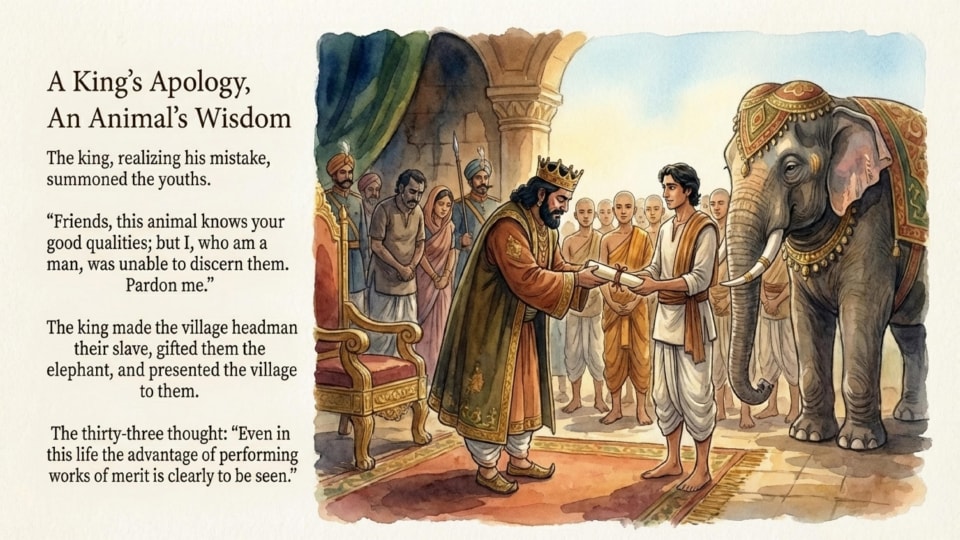
Finally the village headman became angry. “I will destroy them,” he said. So he went to the king and said to him: “Your majesty, I see a band of thieves going about.” The king replied: “Go catch them and bring them before me.” So the village headman arrested the thirty-three youths and hauled them before the king. Without instituting an inquiry into their conduct, the king gave the following order: “Have them trampled to death by an elephant.”
Thereupon Magha admonished his companions as follows: “Friends, we have no refuge but loving-kindness. Therefore let your hearts be tranquil. Cherish anger towards no one. Let your hearts be full of loving-kindness for the king and the village headman and the elephant that tramples you under his feet.” The thirty-three youths followed the admonition of their leader. Such was the power of their loving-kindness that the elephant dared not approach them.
When the king heard of this, he said:
“Your majesty, it is not true that we are thieves. The fact is, we are clearing a path to heaven for ourselves, and we do this and that. The village headman tried to persuade us to adopt a wicked mode of life, and when we refused to follow his suggestions, he became angry at us and determined to destroy us. That is why he said this about us.” – “Friends, this animal knows your good qualities; but I, who am a man, was unable to discern them. Pardon me.” So saying, the king made the village headman their slave, together with his children and wife, gave them a riding-elephant, and presented that village to them to do with as they saw fit. The thirty-three youths thought: “Even in this life the advantage to be derived from the performance of works of merit is clearly to be seen.” And mounting the elephant by turns, they rode about the village.
As they went about the village, they took counsel together,
Now there were four women living in Magha’s house, Nandā, Cittā, Sudhammā, and Sujātā. Sudhammā went secretly to the builder, gave him a bribe, and said to him: “Friend, give me the principal share in the building of this hall.” – “Very well,” replied the builder, agreeing to her proposal. Accordingly he first marked a tree out of which to make a pinnacle, felled it, and laid it aside to season. Then he hewed it and planed it and bored it, and having fashioned it in the form of a pinnacle, carved the following inscription on it: “This is the Hall of Sudhammā.” Having so done, he wrapped it in a cloth and laid it aside.

Now when he had completed the hall and the day came to erect the pinnacle, he said to the thirty-three youths: “Noble sirs, there is something we have forgotten.” – “What is it, sir?” – “A pinnacle.” – “Let us procure one.” – “It is impossible to make one out of a freshly hewn tree. We should procure for a pinnacle a tree felled long ago and laid away to season.” – “What had we best do under the circumstances?” – “If in anybody’s house there is a completed pinnacle which has been laid away to season and which is for sale,
Sudhammā said: “If you will give me a share in the building of the hall, I will give you the pinnacle.” But they replied: “We have resolved to give women no share in the building of this hall.” Thereupon the builder said to them: “Noble sirs, what are you doing? With the exception of the world of Brahma, there is no place from which women are excluded. Take the pinnacle, for if you do, our work will speedily be finished.” – “Very well,” said they. So they took the pinnacle and completed the hall. And they divided the hall into three parts, reserving one chamber for kings, another for the poor, and another for the sick.
Then the thirty-three youths built thirty-three seats, and having so done, gave the following orders to the elephant: “If a visitor comes and sits down in a seat, take him and lodge him in the house of whoever built and owns that seat. It then becomes the duty of the owner of that seat to see that his guest’s feet and back are rubbed, to provide him with food both hard and soft, and with lodging; to perform for him, in fact, all the duties of hospitality.” Accordingly, whenever a visitor came, the elephant would take him and conduct him to the house of the owner of the seat in which he had sat, and the owner of the seat would on that day perform for him all the duties of hospitality.
Magha planted an ebony tree near the hall and built a stone seat at the foot of the ebony tree. All those who entered the hall looked at the pinnacle, read the inscription, and said: “This is the Hall of Sudhammā.” The names of the thirty-three youths did not appear.
Nandā thought to herself: “The youths who built this hall resolved to deprive us of a share in the building thereof.
Cittā thought to herself: “Sudhammā has given a pinnacle, and Nandā has caused a swimming-pool to be built. What can I do?” Thereupon the following thought occurred to her: “After those who come to the hall have drunk water and bathed, they should be decked with garlands when they are ready to depart. I will cause a flower garden to be laid out.” So Cittā caused a beautiful flower garden to be laid out. So many and so various were the flowers that grew therein
Now Sujātā thought to herself: “I am the daughter of the brother of the mother of Magha and likewise the wife of Magha. The merit of the work he has wrought accrues to me only, and the merit of the work I have wrought accrues to him only.” Accordingly she did nothing but spend her time adorning herself.
Thus did Magha minister to his mother and father, honor his elders in the household, speak the truth, avoid harsh words, avoid backbiting, put away avarice, suppress anger. Even thus did he fulfill the seven vows, as it is said:
A man who supports mother and father,
who pays respect to elders in the clan,
who is gentle and kind in conversing,
who has abandoned speech that’s divisive,
devoted to removing selfishness,
who is truthful, overcoming anger,
that one even the Devas of Tāvatiṁsa
speak, saying that he is a good person.
Having attained so praiseworthy a state, Magha, upon reaching the end of the term of life allotted to him, was reborn in the Realm of the Thirty-Three as Sakka, the Lord of the Devas. His companions were likewise reborn there. The builder was reborn as Devaputta Vissakamma.

7c The Realm of the Thirty-Three
Now at that time there were Devas and Asuras dwelling in the Realm of the Thirty-Three, and when they learned that new gods had been reborn there, they prepared celestial drink for them. But Sakka gave orders to his retinue that no one should drink thereof. The Asuras, however, drank freely and became intoxicated. Thereupon Sakka thought to himself: “Why should I share my kingdom with these Devaputtas?” Forthwith, giving a sign to his retinue, he caused them to pick up the Asuras by the heels and fling them into the Great Ocean. So the Asuras fell headlong into the Ocean. By the power of their merit there sprang up at the foot of Mount Sineru in the palace of the Asuras and the tree that is called the Pied Trumpet-flower.
When the conflict between the gods and the Asuras was over and the Asuras had been defeated, there came into existence the city of the Thirty-Three. The distance from the eastern gate to the western gate was ten thousand leagues, and the distance from the southern gate to the northern gate was the same. Now this city was provided with a thousand gates and was adorned with gardens and pools, and in the midst thereof,
As the result of the planting of the ebony tree, there arose the coral tree, a hundred leagues in circumference. As the result of the building of the stone seat, there came into existence at the foot of the coral tree the Yellowstone throne, of a reddish yellow color like that of the jasmine flower, sixty leagues in length, fifty leagues in breadth, and fifteen leagues thick. When Sakka sits down on this throne, half its mass sinks into the ground; when he rises, it is all above ground. The elephant was reborn as god Erāvaṇa. There are no animals in the Deva Realm; so when he went into the garden to play, he would quit his form as a god and become the elephant Erāvaṇa, a hundred and fifty leagues in size. For the thirty-three youths, Erāvaṇa created thirty-three waterpots, each two or three quarters of a league around.
In the center of all, Erāvaṇa created for Sakka a waterpot called Sudassana. It was thirty leagues in circumference, and above it was a canopy, twelve leagues in size, made entirely of precious stones.
7d Sakka’s Former Wives
When Sudhammā died, she was also reborn there. And at the same time there came into existence Sudhammā, the meeting hall of the Devas, nine hundred leagues in extent, than which exists no other place more charming.

Sakka surveyed his wives and considered within himself: “Sudhammā has been reborn here and likewise Nandā and Cittā. Now where has Sujātā been reborn?” Perceiving that she had been reborn as a crane in a mountain-cave, he thought to himself: “Because she wrought no work of merit, the foolish girl has been reborn as a bird. It is my duty to have her perform some work of merit and bring her here.”
So saying, he laid aside his proper form, and assuming a disguise, he went to her and asked: “What are you doing here?” – “But, master, who are you?” – “I am your husband, Magha.” – “Where were you reborn, husband?” – “I was reborn in the Realm of the Thirty-Three. Do you know where your companions were reborn?” – “No, husband, I do not.” – “They also were reborn in the Realm of the Thirty-Three as my wives. Should you like to see your companions?” – “How can I get there?” Said Sakka: “I will carry you there.”
Placing her in the palm of his hand, he carried her to the Deva Realm and set her free on the bank of the lotus-tank named Nandā. Then he said to the other three: “Should you like to see your companion Sujātā?” – “Sire, where is she?”
Sakka went once more to her and said: “Did you see your companions?” – “Yes,” replied Sujātā: “I saw them. They ridiculed me and then went their way. Take me back again.” So Sakka took her back again, set her free in the water, and then asked her: “Did you see their celestial glory?” – “Yes, Sire, I did.” – “You also should employ such means as will enable you to obtain rebirth there.” – “Sire, what shall I do?” – “If I admonish you, will you keep my admonition?”
Thenceforth she sought after and ate only such fish as had died a natural death. After a few days had passed, Sakka determined to test her. So he went, and taking the form of a fish, lay down on the surface of the sand, pretending to be dead. When she saw the fish, thinking that it was dead, she took it in her beak. Just as she was about to swallow the fish, it wriggled its tail. The instant she discovered the fish was alive she released it in the water. Sakka waited a little while, and then lay down before her on his back once more. Again thinking it was a dead fish, she took it in her beak. But just as she was about to swallow the fish, it moved the tip of its tail. The instant she saw the fish move its tail she knew it was alive, and therefore let it go.
When Sakka had thus tested her three times and had satisfied himself that she was keeping the precepts faithfully, he revealed his identity to her and said: “I came here for the purpose of testing you. You are keeping the precepts faithfully. If you continue thus faithfully to keep them,
Thenceforth she used for food either fish that had died a natural death or none at all. After only a few days had passed, she shriveled up and died, and solely as the fruit of her virtuous conduct was reborn at Bārāṇasī as the daughter of a potter. When she was about fifteen or sixteen years old, Sakka considered within himself: “Where has she been reborn?” Perceiving that she had been reborn at Bārāṇasī as the daughter of a potter, he said to himself: “I ought now to go to her.”
So filling a cart with the seven kinds of precious stones disguised as cucumbers, he drove into the city of Bārāṇasī. “Come, get cucumbers!” he cried, as he entered the street. But when people came to him with coins in their hands, he said: “I do not part with my cucumbers for a price.” – “On what terms do you part with them, then?” the people asked him. “I give them to the woman that keeps the precepts,” he replied. “Master, what do you mean by ‘precepts’? Are they black or brown or of some other color?” – “You don’t even know what precepts are; much less will you keep them. I will give my cucumbers to the woman who keeps the precepts.”
“Master, there is a potter’s daughter who is always going about saying: ‘I keep the precepts.’ Give them to her.” The potter’s
At the end of her existence as a potter’s daughter she was reborn in the world of the Asuras as the daughter of Vepacitti, king of Asuras, a bitter enemy of Sakka. Since she had kept the precepts in two successive existences, she was fair of form, her skin was of a golden hue, and she was endowed with beauty and comeliness the like of which had never been seen. Vepacitti, king of Asuras, said to all the Asura princes who sought her in marriage: “You are not fit to marry my daughter.” Having thus refused to give her in marriage to any of the Asura princes, he said: “My daughter shall choose for herself such a husband as she sees fit.” So saying, he assembled the host of Asuras, and placing a garland of flowers in the hand of his daughter, said to her: “Choose for yourself a husband who suits you.”
At that moment Sakka looked to see where she had been reborn. Perceiving what was taking place, he assumed the form of an aged Asura and went and stood in the outer circle of the assembled company. The daughter of Vepacitti looked this way and that. Suddenly, because in a previous state of existence she had lived with Sakka, she was overwhelmed as by a mighty torrent by the power of the love for him which sprang up within her. And crying out: “He is my husband!” she threw the garland of flowers over his head. Said the Asuras: “For a long time our king has been unable to find a husband suitable for his daughter. Now, however, he has found one. This fellow is old enough to be his daughter’s grandfather.”
Sakka took her by the hand, cried out: “I am Sakka,” and flew up into the air. The Asuras exclaimed: “We have been fooled by Old Sakka,” and started up in pursuit. Mātali the charioteer brought up the chariot called the Chariot of Victory and stopped by the way. Thereupon Sakka assisted his bride to mount and set out for the city of the Devas. Now when they reached the forest of the Silk-cotton Trees, the Garuḍa fledglings, hearing the sound of the chariot and fearing they would be crushed to death, cried out.
When Sakka heard their cries, he asked Mātali: “What are they that are crying?” – “Garuḍa birds, Sire,” – “Why are they crying?” – “They hear the sound of the chariot and fear they will be crushed to death.” – “Let not so numerous a host perish, crushed by the impact of the chariot, because of me alone. Cause the chariot to turn back.” Thereupon Mātali gave the sign with the lash to the thousand Sindh horses and caused the chariot to turn back.
When the Asuras saw that the chariot had turned back, they said: “Old Sakka started out in flight from the city of the Asuras, but has just caused his chariot to turn back. Doubtless he has received reinforcements.” And turning back, the Asuras entered the city of the Asuras by the same road by which they had come out and nevermore lifted up their heads. Sakka bore the Asura maiden Sujātā to the city of the Devas and installed her as the chief of twenty-five million Accharās.
One day Sujātā asked Sakka for a boon, saying: “Great king, in this Deva Realm I have neither mother nor father nor brother nor sister; therefore pray take me with you wherever you go.”
Thus, Mahāli, Prince Magha adopted the way of heedfulness. Because he was so heedful, he obtained such sovereignty so exalted and came to rule over the two worlds of the Devas. Heedfulness is praised by the Buddhas and by others likewise. For it is through heedfulness that all attain the higher attainments, both those that are of this world and those that transcend this world.” So saying, he pronounced the following verse:
30. Appamādena Maghavā devānaṁ seṭṭhataṁ gato,
appamādaṁ pasaṁsanti, pamādo garahito sadā.
Through heedfulness did Maghavā
attain leadership of the gods,
the good always praise heedfulness,
but heedlessness is always blamed.
At the conclusion of the verse the Licchavī Mahāli was established in the fruition of Stream-entry, and many of the assembly became Stream-enterers and so on.
