13.6 The Story about the Elder Aṅgulimāla
Aṅgulimālattheravatthu
Dhp 173
Burlingame: Conversions of the Robber Finger-Garland
Compare: MN 86
Aṅgulimāla was misled into killing many hundreds of people, but later met the Buddha who converted him and he soon became an Arahat; later he was recognised as the former killer and was stoned to death; the bhikkhus asked where he was reborn, and the Buddha explained he was not reborn at all, and spoke a verse about him.
Keywords: Great Disciples, Thieves, Murder, Conversions, Kings
****
“The person whose wicked deed,” this Dhamma teaching was given by the Teacher while he was in residence at Jetavana with reference to Elder Aṅgulimāla (Finger Garland).
6a The Discourse about Aṅgulimāla
Thus have I heard:
Now one morning the Fortunate One put on his undergarment, took bowl and robe, and entered Sāvatthī for alms. Having made his rounds for alms in Sāvatthī, he returned from his rounds; and after eating his breakfast, put his lodgings in order, took bowl and robe, and went into the highway where lurked the robber Aṅgulimāla.
Cowherds, herdsmen, and farmers ran up and saw the Fortunate One going into the highway where lurked the robber Aṅgulimāla, and seeing him, addressed the Fortunate One as follows: “Ascetic, do not go along this road. On this road, ascetic, lurks a robber named Aṅgulimāla. He is cruel, red-handed, given to killing and slaying, devoid of compassion for all living beings. He has wrought such havoc with villages that villages they are no more, such havoc with towns that towns they are no more, such havoc with districts that districts they are no more. He kills man after man and wears a garland made of their fingers. For, ascetic, many a time ten men, or twenty men, or thirty men, or forty men band themselves together and go along this road, and all of them perish at the hands of the robber Aṅgulimāla.” In spite of their warning the Fortunate One continued on his way in silence.
Again for a second time cowherds, herdsmen, and farmers ran up and addressed the Fortunate One as follows: “Ascetic, do not go into this road . . . and all of them perish at the hands of the robber Aṅgulimāla.” The Fortunate One a second time continued on his way in silence.
Again, the third time cowherds, herdsmen, and farmers ran up and addressed the Fortunate One as follows: “Ascetic, do not go into this road . . . and all of them perish at the hands of the robber Aṅgulimāla.” The Fortunate One a third time continued on his way in silence.
Now the robber Aṅgulimāla saw the Fortunate One approaching from afar. When he saw him, the following thought occurred to
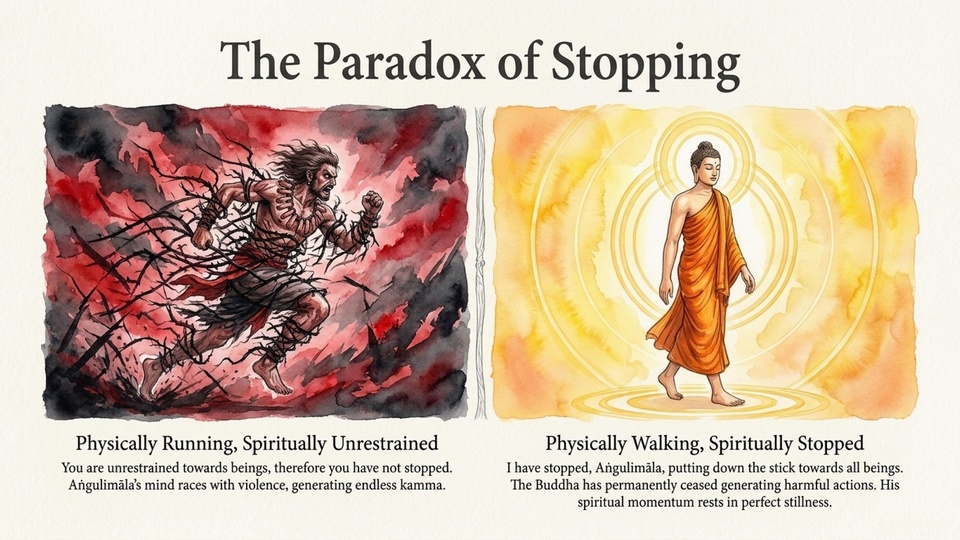
Then the Fortunate One effected such an exercise of supernatural power that although the robber Aṅgulimāla hurried with all his might, and the Fortunate One walked at his usual gait, the robber Aṅgulimāla was unable to catch up with the Fortunate One. Then to the robber Aṅgulimāla occurred the following thought: “How wonderful! How marvelous! Heretofore I have overtaken and caught an elephant, even when running; I have overtaken and caught a horse, even when running; I have overtaken and caught a chariot, even when running; I have overtaken and caught a deer, even when running. But although I am hurrying with all my might and this ascetic is walking at his usual gait, I am unable to catch up with him.” Accordingly Aṅgulimāla stood still and said to the Fortunate One: “Stand still, ascetic! Stand still, ascetic!” – “I stand still, Aṅgulimāla. Do you also stand still!”
Then to the robber Aṅgulimāla occurred the following thought: “These ascetics of the Sākiyan prince speak the truth, utter the truth. But this ascetic says, even in the act of walking: ‘I stand still, Aṅgulimāla. Do you also stand still!’ Suppose now I were to ask this ascetic a question!” Accordingly the robber Aṅgulimāla addressed the Fortunate One with a verse:
“When going, you say, I have stopped,
and to me, you say, you stop not,
I ask about this, ascetic,
how have you stopped, and I have not?”
“I have stopped, Aṅgulimāla, putting
down the stick towards all beings, on all sides,
but you are unrestrained towards beings,
therefore I have stopped, but you have not stopped.”
“At long last, for me there is a renowned
great seer, a truth-speaker has reached this wood,
I will wander, abandoning wickedness,
having hear your verse endowed with Dhamma.”
Thus did the robber take sword and weapons
and threw them into a deep hole, a pit,
the thief, worshipped at the Happy One’s feet,
and requested the going forth right there.
The compassionate Buddha, the great seer,
the Teacher of the world with its Devas
and humans, at that time said: “Come bhikkhu!”
and then he gained the state of a bhikkhu.
Now the Fortunate One set out on a journey to Sāvatthī with the venerable Aṅgulimāla as attendant ascetic, and after journeying from place to place, arrived in due course at Sāvatthī. And there did the Fortunate One take up his residence, in Sāvatthī, at Jetavana, in Anāthapiṇḍika’s Grove.
Now at that time a great multitude assembled at the gate of the palace of King Pasenadi Kosala and raised a hue and cry: “Your majesty, there is a robber in your kingdom, named Aṅgulimāla. He is bloodthirsty, red-handed, given to killing and slaying, devoid of compassion for all living beings. He has wrought such havoc with villages that villages are no more, such havoc with towns that towns are no more, such havoc with districts that districts are no more. He kills man after man, and wears a garland made of their fingers. Let your majesty subdue him.”
Then did King Pasenadi Kosala set out from Sāvatthī early in the day with five hundred horses and proceed in the direction of the grove. Proceeding in his carriage as far as the road was passable for a carriage, he alighted from his carriage, and proceeding on foot, drew near to the place where the Fortunate One was. And having drawn near,
“No, venerable Sir, King Seniya Bimbisāra of Magadha is not provoked at me. Nor the Licchavi princes of Vesālī. Nor any other of my royal adversaries. venerable Sir, there is a robber named Aṅgulimāla in my kingdom. He is bloodthirsty, red-handed, given to killing and slaying, devoid of compassion for all living beings. He has wrought such havoc with villages that villages are no more, such havoc with towns that towns are no more, such havoc with districts that districts are no more. He kills man after man, and wears a garland made of their fingers. And, venerable Sir, I cannot subdue him.”
“But, mighty king, suppose you were to see Aṅgulimāla with his hair and his beard shaven, clad in yellow robes, gone forth from the
“Venerable Sir, we should salute him, we should rise to greet him, we should invite him to occupy a seat, we should ask for the privilege of supplying him with robes, food, lodging, and medicine. We should provide protection, defense, and keeping for him according to the Dhamma. But, venerable Sir, how is it possible that one so wicked, one so utterly devoted to wicked ways, should become so perfectly restrained by the precepts of morality?”
Now at that time the venerable Aṅgulimāla was sitting not far from the Fortunate One. Then did the Fortunate One stretch forth his right arm and address King Pasenadi Kosala as follows: “This, mighty king, is Aṅgulimāla!”
Then was King Pasenadi Kosala stricken with fear, his limbs trembled, and his hair stood on end. Now when the Fortunate One perceived that King Pasenadi Kosala was stricken with fear, that his limbs trembled, and that his hair stood on end, he addressed King Pasenadi Kosala as follows: “Fear not, great king; fear not, great king; you have nothing to fear from him.” Thereupon, whereas before King Pasenadi had been stricken with fear,
Then did King Pasenadi Kosala draw near to the place where sat venerable Aṅgulimāla, and having drawn near, addressed the venerable Aṅgulimāla as follows: “Venerable Sir, is not this our noble Elder Aṅgulimāla?” – “Even so, mighty king.” – “Of what clan, venerable Sir, is our noble elder’s father? Of what clan is his mother?” – “My father, mighty king, is a Gagga; my mother is a Mantāṇī.” AJ: both of these are Brahminical names.
“Venerable Sir, may it please my noble Elder Gagga, son of Mantāṇī: I shall exert myself to the utmost to provide for my noble Elder Gagga, son of Mantāṇī, robes, food, lodging, and medicine.” Now at that time the venerable Aṅgulimāla had adopted the practices known as the forest practice, the alms practice, the refuse-rag practice, and the three-robe practice. Accordingly the venerable Aṅgulimāla answered King Pasenadi Kosala as follows: “Enough, mighty king! My set of three robes is complete.”
Then did King Pasenadi Kosala draw near to the place where sat
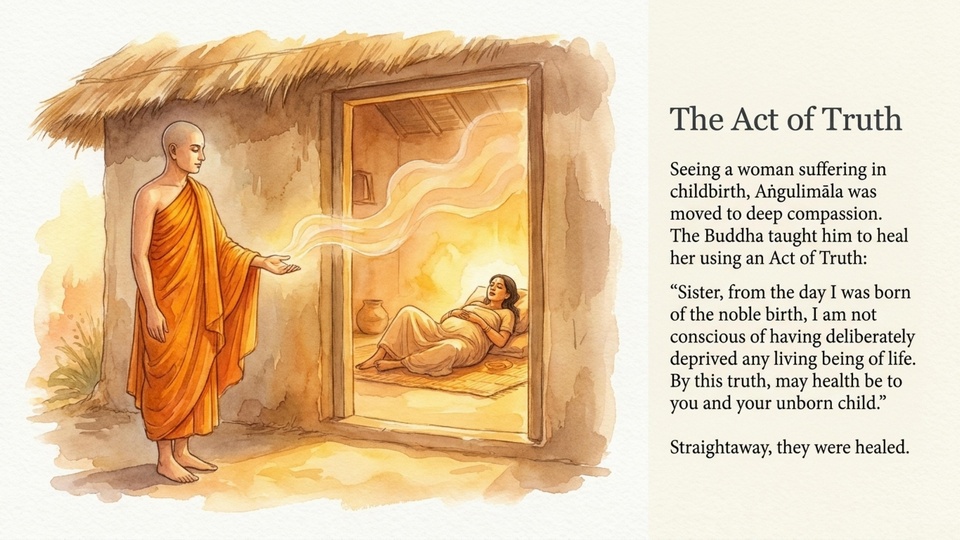
Now one morning the venerable Aṅgulimāla took bowl and robe, and entered Sāvatthī for alms. And as the venerable Aṅgulimāla made his unbroken round of Sāvatthī from house to house, he saw a certain woman in the throes and agonies of childbirth. When he saw her,
Now when the venerable Aṅgulimāla had made his rounds for alms in Sāvatthī, he returned from his rounds, and after eating his breakfast, drew near to the place where sat the Fortunate One. And having drawn near, he worshipped the Fortunate One and sat down respectfully on one side. Now as the venerable Aṅgulimāla sat respectfully on one side, he addressed the Fortunate One as follows: “This very morning, venerable Sir, I took bowl and robe, and entered Sāvatthī for alms. And as I made my unbroken round of Sāvatthī from house to house, I saw a certain woman in the throes and agonies of childbirth. And when I saw her, the following thought occurred to me: ‘Alas, how living beings suffer! Alas, how living beings suffer!’”
“Well then, Aṅgulimāla, draw near to Sāvatthī, and having drawn near, address that woman as follows: ‘Sister, from the day I was born, I am not conscious of having deliberately deprived any living being of life. If this be true, may health be to you, health be to your unborn child.’” – “But, venerable Sir, that would be a deliberate falsehood; for, venerable Sir, I have deliberately deprived a great many living beings of life.” – “Well then, Aṅgulimāla, draw near to Sāvatthī, and having drawn near, address that woman as follows:
“Very well,” replied the venerable Aṅgulimāla. And obeying the command of the Fortunate One, the venerable Aṅgulimāla drew near to Sāvatthī, and having drawn near, addressed that woman as follows: “Sister, from the day I was born of the noble birth, I am not conscious of having deliberately deprived any living being of life. If this be true, may health be to you, health be to your unborn child.” Straightaway there was health to that woman, health to her unborn child. BG: Cf. Dhp-a 26.31; Ja 100; and Ud 2.8. For a discussion of this charm, see my paper. The Act of Truth (Saccakiriya); a Hindu Spell and its Employment as a Psychic Motif in Hindu Fiction, JRAS., 1917, 429-467. For other occurrences of the charm, see Dhp-a 4.4b and Dhp-a 17.3b.
Now the venerable Aṅgulimāla, living in solitude, withdrawn from the world, heedful, ardent, resolute, in no long time, even in this life, himself abode in the knowledge, realisation, and attainment of that supreme goal of the holy life for the sake of which youth of good families retire once and for all from the household life to the houseless life. This did he know: “Destroyed is rebirth, accomplished is the spiritual life, done is what ought to be done, there is no more of this mundane state - this he knows.”
Now one morning the venerable Aṅgulimāla put on his undergarment, took bowl and robe, and entered Sāvatthī for alms. At that time one man threw a clod of earth and hit the venerable Aṅgulimāla’s body, another man threw a stick and hit the venerable Aṅgulimāla’s body, another man threw a stone and hit the venerable Aṅgulimāla’s body.
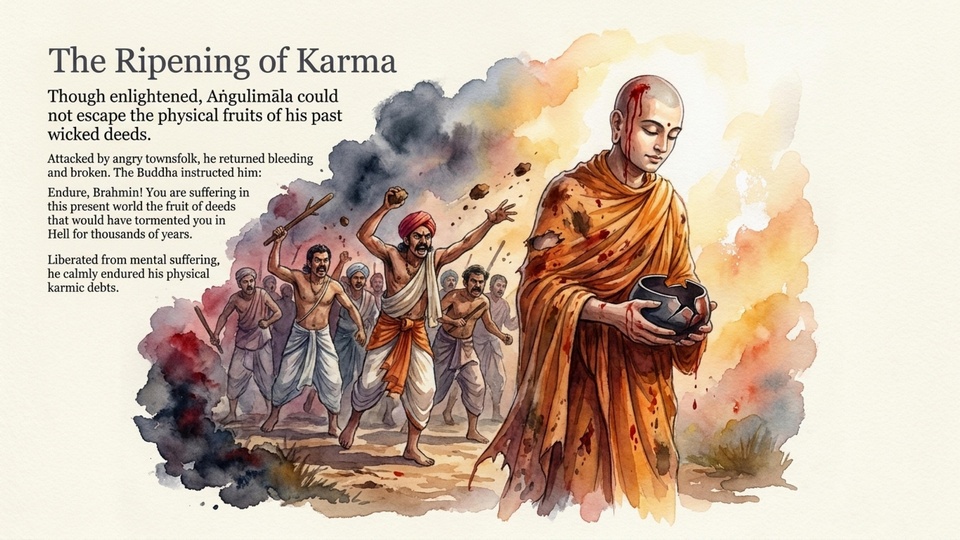
Then did the venerable Aṅgulimāla, with broken head, streaming with blood, with broken bowl, with double robe rent, draw near to the place where sat the Fortunate One. The Fortunate One saw the venerable Aṅgulimāla approaching from afar; and seeing him, addressed the venerable Aṅgulimāla as follows: “Endure, Brahmin! Endure, Brahmin! Brahmin, you are suffering in this present world the fruit of wicked deeds, in consequence of which you might have been tormented in Niraya Hell for many years, for many hundreds of years, for many thousands of years!”
Now the venerable Aṅgulimāla, AJ: this paragraph and the first verse are quoted in Dhp-a. living in solitude, living in seclusion, experiencing the bliss of release, breathed forth at that time the following exalted utterances:
Dhp 172. Whoever was heedless before,
but then later is not heedless,
that one shines brightly on this world
like the moon released from a cloud.
Dhp 173. The person whose wicked deed is
covered over by a good deed –
that one shines brightly on this world
like the moon released from a cloud.
Dhp 382. That young monk who is devoted
to the Buddha’s dispensation,
surely shines forth in this world, like
the moon that is freed from a cloud.
May my foes listen to Dhamma talk,
may my foes be devoted to Buddha’s
Dispensation, may my foes resort to
people who’re good, and accept the Dhamma.
May my foes, from those who speak of patience,
from those who praise not obstructing others,
at the right time may they listen to the
Dhamma, act in conformity with it.
For then they will not wish me harm,
or to any of the others,
having reached the ultimate peace
they will guard those trembling or firm. AJ: MN-a: “Trembling means those with craving; firm means those without craving.”
Dhp 80. Course-makers lead water,
fletchers straighten arrows,
carpenters straighten wood,
the wise master themselves.
Some tame (other people) with a stick,
or with a goad, or with a whip,
without a stick, without a sword
I was tamed by the one unmoved.
Harmlessness (Ahiṁsaka) is my name,
though before I have harmed, today
it is the truth, I harm no one.
Previously I was a thief,
famous as Aṅgulimāla,
floating away on a great flood,
I came for refuge to Buddha.
Previously I was bloody-handed,
I was famous as Aṅgulimāla,
behold, the going for refuge,
removing that which leads to existence.
Having done many such deeds
as lead to a bad rebirth,
touched by the results of deeds,
free from debt, I eat my food.
Dhp 26. Foolish, stupid people
cultivate heedlessness,
the sage guards heedfulness
just as his greatest wealth.
Dhp 27. Do not cultivate heedlessness,
do not take delight in pleasure,
the heedful one, meditating,
surely attains great happiness.
Well received, not ill-received,
not badly advised was I,
in all the things I shared in,
the best was coming to this.
Well received, not ill-received,
not badly advised was I,
attaining three knowledges,
the Buddha’s teaching is done.
When the venerable Aṅgulimāla
173. Yassa pāpaṁ kataṁ kammaṁ kusalena pithīyati –
sŏ imaṁ lokaṁ pabhāseti abbhā mutto va candimā.
The person whose wicked deed is
covered over by a good deed –
that one shines brightly on this world
like the moon released from a cloud.
At the end of the teaching many reached the fruition of Stream-entry and so on.