13.9 The Story about the Young Brahmin Girl Ciñcā
Ciñcamāṇavikāvatthu
Dhp 176
Burlingame: Ciñcā Falsely Accuses the Buddha
Compare: Ja 472; Dhp-a 22.1 BG: The Story of the Present is almost word for word the same as the Introduction to Ja 472. Of the story of Prince Paduma and the queen, only a brief outline is given. Cf. the story of Sundarī, 22.1; also Feer’s comparative study of the stories of Ciñcā and Sundarī in JA., 1897, 288-317.
The young brahmin girl Ciñcā falsely accused the Buddha of impregnating her; the gods helped reveal the lie, and Ciñcā fell into Avīci, the hell of relentless suffering; the Buddha explained the matter with a verse.
Keywords: Gains, Honour, Sectarians, Deceit, Reviling, Past Lives, Bodhisatta
****
“For the person speaking falsely,”
For in the first period after Awakening, the disciples of the One of Ten Strengths multiplied and Devas and humans innumerable descended upon the noble lands. And as the sum of his virtues became noised abroad, rich gain and high honor were bestowed upon him. But as for the sectarians, gain and honor were lost to them alike, even as fireflies lose their brilliance before the coming of the sun. And they gathered in the street and cried out: “Is the ascetic Gotama the only Buddha? We also are Buddhas! Does that alone which is given to him yield abundant fruit? That which is given to us returns abundant fruit also. Therefore do you give alms to us; bestow honor upon us.” With such words as these did they appeal to the multitude,
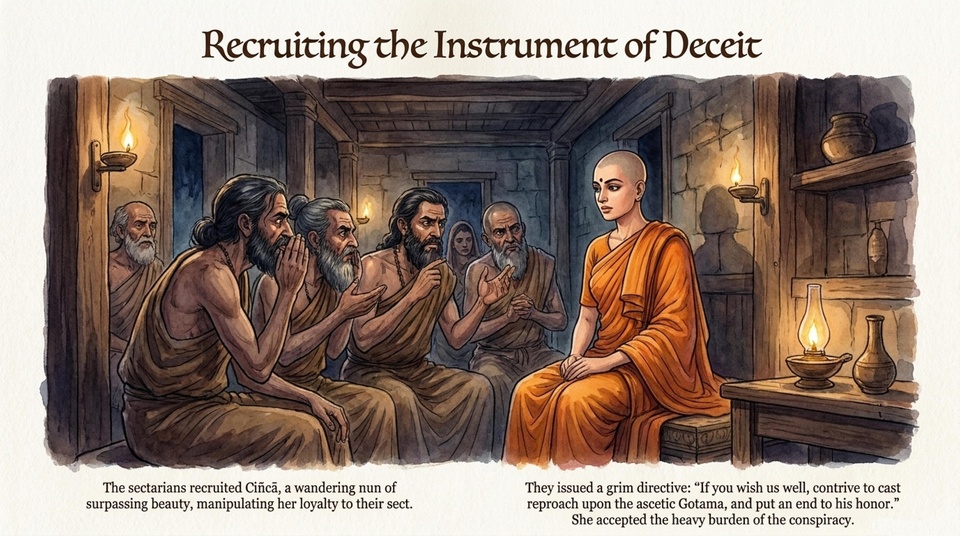
Now at that time there lived in Sāvatthī a certain wandering nun known as the young brahmin girl Ciñcā. She possessed surpassing beauty and loveliness; a very Devaccharā was she; from her body proceeded forth rays of light. Now a certain harsh counselor made this proposal: “With the assistance of this woman we shall be able to cast reproach upon the ascetic Gotama, and so put an end to the gain and honor bestowed upon him.” – “That is the way!” exclaimed the sectarians, agreeing to his proposal.
The young brahmin girl Ciñcā went to the monastery of the sectarians, saluted them, and stood waiting; but the sectarians had nothing to say to her. Thereupon she said: “What fault do you find in me?” This question she repeated three times; then she said: “Noble sirs, I appeal to you for an answer. Noble sirs, what fault do you find in me? Why do you not speak to me?” – “Sister,” replied the sectarians, “know you not the ascetic Gotama, who goes about doing us harm, depriving us of gain and honor alike?”
From that time on, she employed all of her skill in the arts of a woman to effect her purpose. When the residents of Sāvatthī were returning from Jetavana after listening to the Dhamma, she would put on a cloak of red color, and bearing perfumes and garlands in her hands, would walk in the direction of Jetavana. “Where are you going at this time of day?” people would ask her. “What business of yours is it where I am going?” she would reply. She would spend the night near Jetavana at the monastery of the sectarians, and early the following morning, when throngs of lay disciples were coming out of the city for the purpose of rendering the morning greeting to the Teacher, she would wend her way back and reenter the city. “Where have you spent the night?” people would ask her. “What business of yours is it where I have spent the night?” she would reply.
After the lapse of a month and a half, whenever they asked her this question, she would reply: “I spent the night at Jetavana alone with the ascetic Gotama in the Perfumed Chamber.” And by her answer she caused doubts and misgivings to spring up in the minds of those who were still unattained. And, they said to themselves: “Is this true, or is it false?” When three or four months had gone by, she wrapped her belly about with bandages, to create the impression that she was pregnant, and dressing herself in a scarlet cloak, she went about, saying: “I have conceived a child by the ascetic Gotama.” Thus did she deceive blind fools.
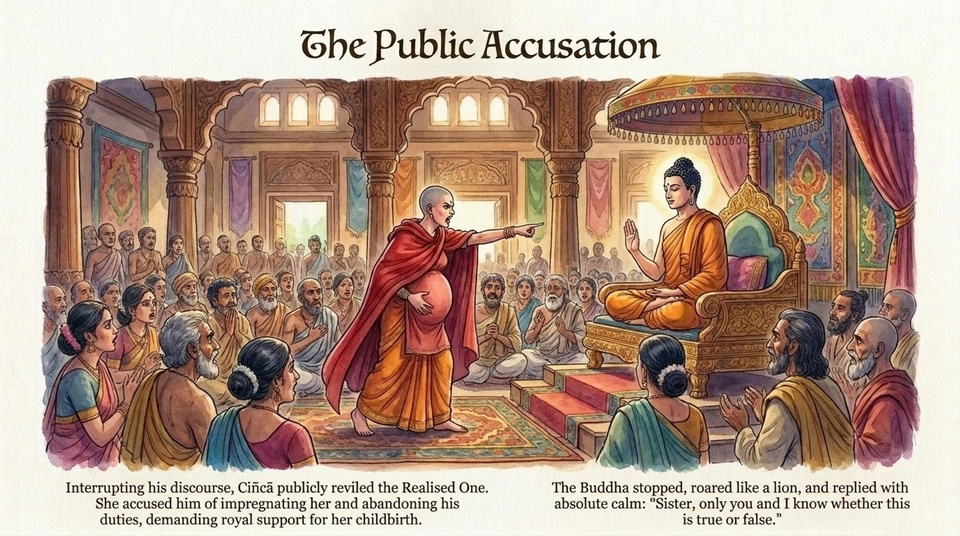
When eight or nine months had gone by, she fastened a disk of wood to her belly, drew a cloak over it,
There, in his gloriously adorned Dhamma Seat, sat the Realised One, teaching the Dhamma. And standing there before him, the young brahmin girl Ciñcā opened her lips and reviled him, saying: “Great ascetic, mighty is the throng to which you teach the Dhamma; sweet is your voice, soft are your lips. Nevertheless you are the one by whom I have conceived a child, and the time of my delivery is near at hand. But in spite of all this, you make no effort to provide a lying-in chamber for me, nor do you offer to provide me with ghee and oil and such other things as I need. And failing yourself to attend to this your duty, neither do you say to any one of your supporters, the king of Kosala, or Anāthapiṇḍika, or Visākhā, your eminent female lay disciple: ‘Do for this young woman what should be done for her.’ You know well enough how to take your pleasure, but you know not how to look after the child you have begotten.” Thus did she revile the Realised One in the midst of the assembly, even as a woman with a mass of dung in her hand might seek therewith to defile the face of the moon.
The Realised One stopped his discourse, and roaring like a lion, cried out: “Sister, as to whether what you have said be true or false, that is something which only you and I know.” – “Yes, great ascetic, but who are to decide between the truth and the falsehood of what is known only to you and to me?”
At that moment Sakka’s seat showed signs of heat. Thereupon Sakka pondered the cause, and became aware of the following: “The young brahmin girl Ciñcā is falsely accusing the Realised One.” Thereupon Sakka said to himself: “I will clear up this matter,” and
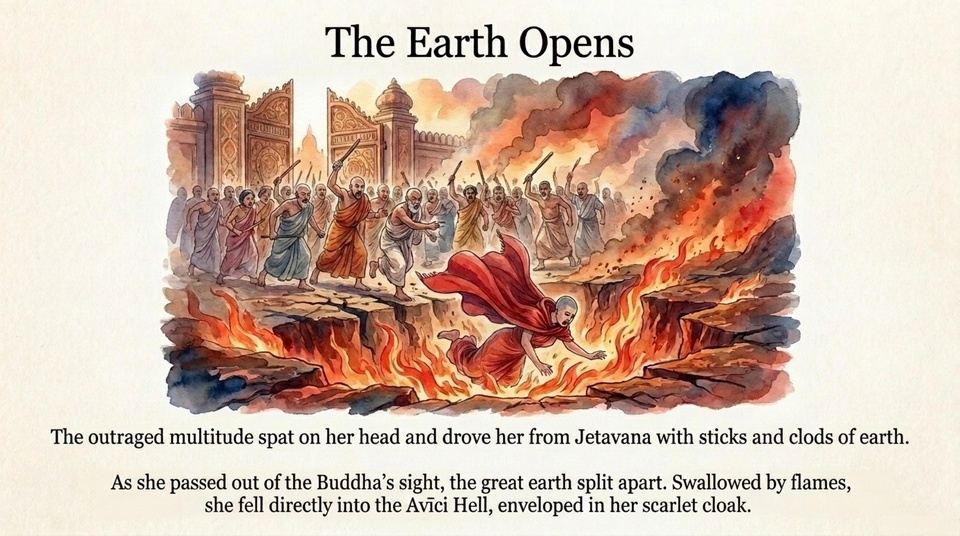
Thereupon the multitude cried out: “This wretch is reviling the Sambuddha.” Forthwith they spat on her head, and taking clods of earth and sticks in their hands, drove her out of the Jetavana. As she passed out of sight of the Realised One, the great earth split apart, an abyss opened under her feet, and flames shot up from the Avīci Hell. Thus was she swallowed up, enveloped as it were in a scarlet blanket such as is presented by wealthy families, and reborn in the Avīci Hell. From that time the gain and honor of the sectarians decreased, but the offerings presented to the One of Ten Strengths increased more and more.
On the following day the bhikkhus began a discussion in the Dhamma Hall: “Friends, the young brahmin girl Ciñcā, because she falsely accused the one of eminent virtues, the foremost recipient of offerings, the Sambuddha, came to utter ruin.”
The Teacher approached and asked: “Bhikkhus, what are you sitting here now talking about?” When they told him, he said: “Bhikkhus, this is not the first time she has falsely accused me and come to utter ruin; she did the same thing in a previous state of existence also.” Having thus spoken, he said:
Without seeing another’s faults,
small or great, in every way,
a king should not adjudicate,
without seeing it for himself.
So saying, he related in detail the Birth Story about (Prince) Mahāpaduma, AJ: Ja 472, an abbreviated version of which follows. found in the Twelfth Nipāta.
9a Story of the Past: The Lewd Woman and the Virtuous Youth
At that time, it appears, the young brahmin girl Ciñcā was reborn as one of the chief consorts of the king, fellow-wife of the mother of the Bodhisatta, Prince Mahā Paduma. She invited the Great Being to lie with her, and when he refused to do so, disfigured her own body with her own hands, feigned sickness, and told the king: “Your son brought me to this pass because I would not lie with him.”
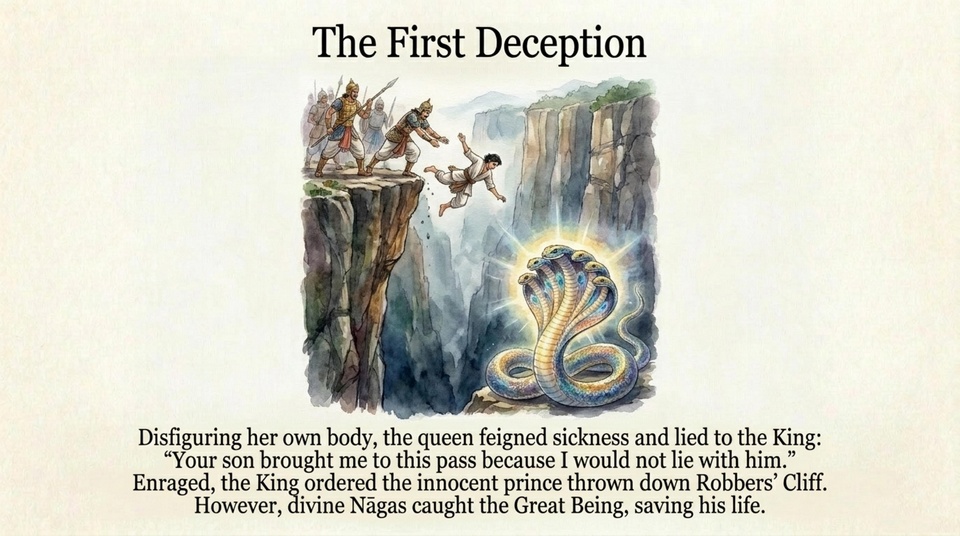
The Deva dwelling in the mountain chasm cared for him and placed him safe and sound within the hood of the Nāga King. The Nāga King carried him to the Abode of the Nāgas and honored him by conferring upon him half his kingly power. After the Great Being had dwelt there for a year, he conceived a desire to go forth. Accordingly he went to the Himālaya country, went forth, and in the course of time developed the absorptions and the super knowledges.
Now a certain forester happened to see him there and reported the matter to the king. Thereupon the king went to him, exchanged friendly greetings with him, learned what had happened, and offered to bestow his kingdom upon the Great Being. The Great Being, however, declined his offer and admonished him as follows: “For my part, I have no desire to rule. But as for you, do you keep unimpaired the ten royal virtues, avoid wrong courses, and rule your kingdom justly.” Thereupon the king arose from his seat in tears and went back to the city. On the way there he asked his ministers: “Through whose fault was I separated from one endowed with such uprightness?” – “Your chief consort was to blame for this, your majesty.” Thereupon the king had her taken by the heels and flung head foremost down Robbers’ Cliff. And entering his city, thenceforth he ruled his kingdom justly. At that time Prince Mahā Paduma was the Great Being, and the fellow-wife of his mother was the young brahmin girl Ciñcā.
When the Teacher had made this matter clear, he said: “Bhikkhus, in the case of those who have broken one commandment, those who have ceased to speak the truth, who have become confirmed in falsehood, who have abandoned hope of the next world, there is no wicked deed which they will not commit.” So saying, he pronounced the following verse:
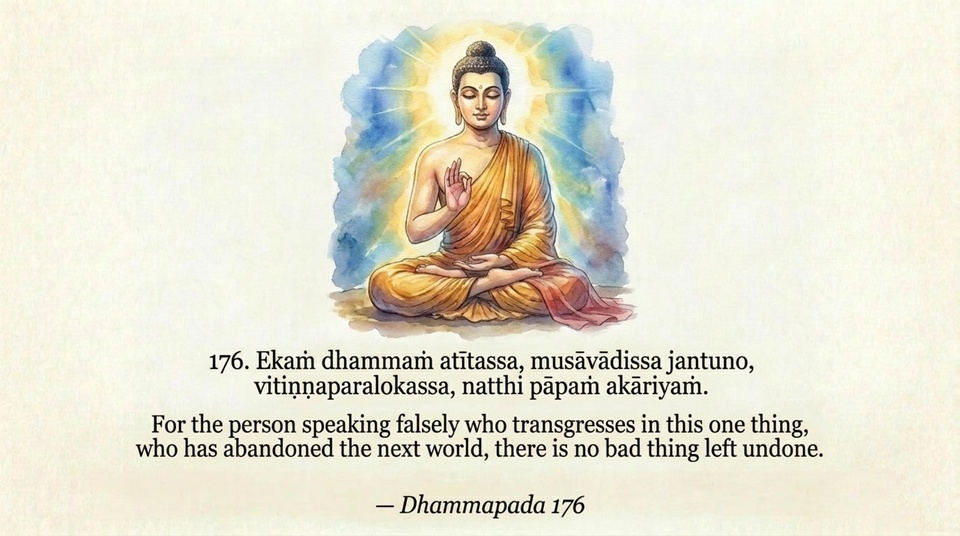
176. Ekaṁ dhammaṁ atītassa, musāvādissa jantuno,
vitiṇṇaparalokassa, natthi pāpaṁ akāriyaṁ.
For the person speaking falsely
who transgresses in this one thing,
who has abandoned the next world,
there is no bad thing left undone.
At the end of the teaching many reached the fruition of Stream-entry and so on.