13.10 The Story about the Gifts beyond Compare
Asadisadānavatthu
Dhp 177
Burlingame: Gifts beyond Compare
Compare: DN-a 19
King Pasenadi gave Gifts beyond Compare to the Saṅgha with the Buddha at its head, something which happens only once in a lifetime; one of the king’s ministers rejoiced, but another regretted the expenditure; the first was richly rewarded and the second was banished from the kingdom; the Buddha then spoke a verse about the situation.
Keywords: Kings, Offerings, Women, Merit, Ministers
****
“The miserly go not to the world of Devas,”
Gifts beyond Compare
For once upon a time the Teacher returned from an almsround with his retinue of five hundred bhikkhus and entered the Jetavana. Thereupon the king went to the monastery and invited the Teacher to be his guest. On the following day he caused rich gifts to be prepared for the visiting bhikkhus and then summoned the citizens, saying: “Let them come here and behold the gifts which I have prepared.” The citizens went there and beheld the gifts which the king had prepared. On the following day the citizens invited the Teacher to be their guest, and having prepared offerings, sent word to the king, saying: “Let the king come here and behold the offerings which we also have prepared.”
When the king saw the offerings which the citizens had prepared, he thought to himself: “These citizens have given more abundant offerings than I have; I will therefore present offerings a second time.” Accordingly he prepared offerings on the following day; when the citizens saw the offerings which the king had prepared, they also prepared offerings on the next day.
Thus it happened that neither the king was able to outdo the citizens, nor
As he lay there. Queen Mallikā approached him and asked him: “Your majesty, why do you lie here thus? What makes you look so worn and weary?” The king said: “My lady, do you not know?” Said the queen: “My lord, I do not know.” So the king told her all about it. Then said Queen Mallikā to him: “My lord, be not disturbed; have you ever seen or heard of a king, a lord of the land, who has been outdone by his subjects? I will manage the offerings.”
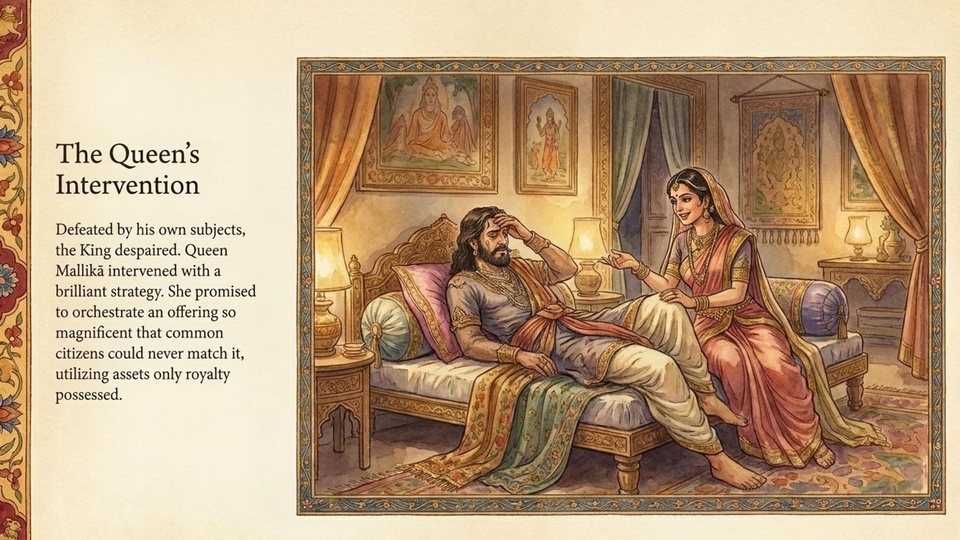
Then she said to the king: “Great king, give orders for the erection of a pavilion enclosing a circular space wherein bhikkhus shall sit to the number of five hundred, and let this pavilion be constructed out of the choicest wood of the Sāla tree; let the rest of the bhikkhus sit outside of this enclosed space.
Order five hundred white parasols to be made, and let five hundred elephants take these parasols in their trunks and stand and hold them over the heads of the five hundred bhikkhus. Have eight or ten boats made of ruddy gold, and let them be placed in the center of the pavilion. Between every two bhikkhus let a young woman of the noble caste sit and crush perfumes. Let certain young women of the noble caste take fans in their hands, and let each young woman stand and fan two bhikkhus. Let other young women of the noble caste bring crushed perfumes in their hands and cast them into the golden boats.
It happened, however, that one bhikkhu lacked an elephant. When the king observed this, he said to Mallikā: “Dear wife, a single bhikkhu lacks a single elephant. What shall I do?” – “What say you, my lord? Are there not five hundred elephants?” – “Yes, my lady, there are. But the rest are rogue elephants, and when they see the bhikkhus, they are wont to become as wrathful as the monsoon winds.” – “My lord, I know where a certain young rogue elephant might stand, holding a parasol with his trunk.” – “Where shall we place him?” – “Beside the noble Aṅgulimāla.” The king did so. Thereupon the young elephant thrust his tail between his legs, dropped both his ears, closed his eyes, and stood motionless. The multitude gazed at the elephant in wonderment, thinking to themselves: “What a way for so vicious an elephant to behave!”
The king waited upon the Saṅgha of bhikkhus presided over by the Buddha. Having so done, he worshipped the Teacher, and said to him: “Venerable Sir, whatsoever goods are in this refectory, whether they be worthy or unworthy, I present them all to you.”
Now in this act of almsgiving 140 million of treasure were given away in one single day. Four objects of priceless value were placed at the disposal of the Teacher: a white parasol, a couch whereon to rest, a stand, and a footstool. No one who gave gifts to the Buddhas thereafter was able to equal the gifts which were then presented by the king, wherefore those gifts came to be known as Gifts beyond Compare. It seems that this happens once to all the Buddhas, and that a woman always manages this for all.
The Two Ministers
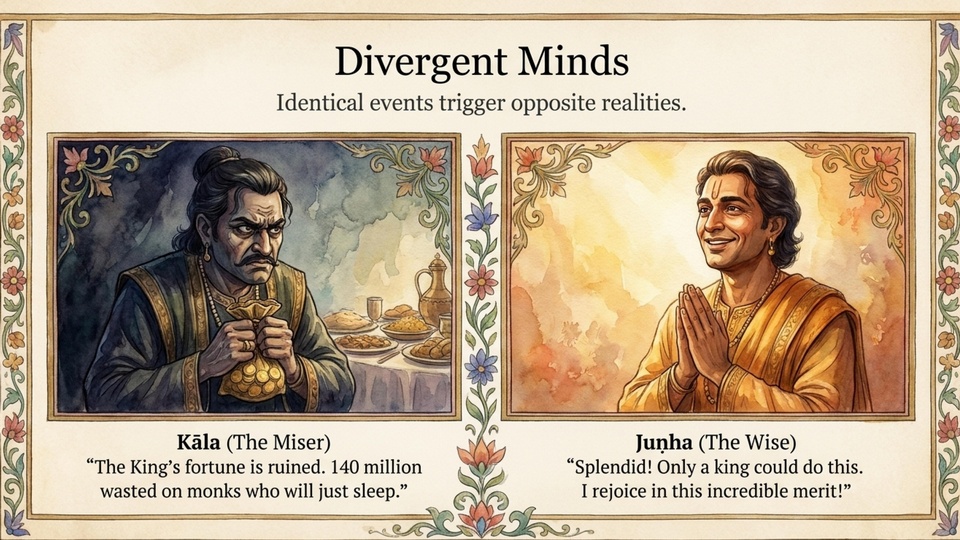
Now the king had two ministers named Kāla (Dark) and Juṇha (Bright). Kāla thought to himself: “How the king’s fortune has diminished! In one single day 140 million of treasure have been spent! And these bhikkhus, after feasting upon these alms, will go away, lie down, and sleep! How the king’s fortune has been wasted!”
But Juṇha thought to himself: “Oh, what splendid gifts the king has presented! No one who does not occupy a king’s station could make such a gift! Moreover, none make over the merit of their gifts to all living beings! As for me, I am thankful for these gifts which the king has presented!”
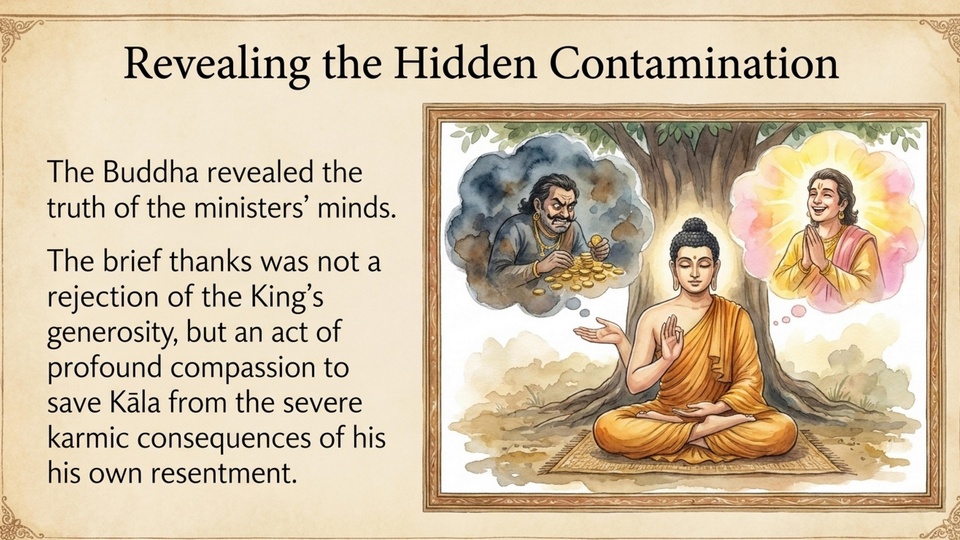
When the Teacher had finished his meal, the king took his bowl, that he might pronounce the words of thanksgiving. The Teacher thought to himself: “The king has given mighty gifts, like as when one sets in motion a mighty flood. Will the hearts of the populace be filled with faith, or will they not?” Perceiving the disposition of mind of those ministers, he became aware of the following: “If I pronounce words of thanksgiving appropriate to the gifts which the king has given, Kāla’s head will split into seven pieces, and Juṇha will be established in the fruition of Stream-entry.” Therefore, out of pity for Kāla, he recited but a single verse consisting of four lines in honor of the king, who stood before him after giving gifts so splendid. Having so done, he arose from his seat and returned to the monastery.
The bhikkhus asked Aṅgulimāla: “Friend, were you not afraid when you saw the rogue elephant standing before you, holding a white parasol?” – “No, friends, I was not afraid.”
The bhikkhus said to the Teacher: “Venerable Sir, Aṅgulimāla utters falsehood.” The Teacher replied: “Bhikkhus, Aṅgulimāla has no fear. For bhikkhus like my son are all the noble ones who have rid themselves of the pollutants, the noblest and have no fear.” So saying, he pronounced the following verse in the Chapter about Brahmins:
Dhp 422. A noble leader, heroic,
a great seer, victorious,
free of lust, cleansed and awakened,
that one I say is a Brahmin.
The king was bitterly disappointed. He thought: “After I had given gifts to so numerous a company, and had taken my stand before the Teacher, the Teacher omitted to pronounce words of thanksgiving commensurate with my gifts, uttered but a single verse, and then arose from his seat and departed. It must be that instead of presenting gifts appropriate to the Teacher, I presented gifts that were inappropriate; it must be that instead of giving such things as were suitable for gifts, I gave such things as were unsuitable for gifts. It must be that the Teacher is angry with me, for it is his invariable practice to return thanks to anyone whosoever in terms commensurate with gifts presented.”
With this thought in mind, he went to the monastery, worshipped the Teacher, and said this to him: “Venerable Sir, did I fail to give gifts such as I should have given, or err by giving, instead of such things as were suitable for gifts, things that were unsuitable for gifts?”
The king asked Kāla: “Is it true, Kāla, that you entertained these thoughts?” – “It is true,” replied Kāla. Then said the king: “I never took what belonged to you, but with the assistance of son and wife, gave only what belonged to me. Wherein have I done you wrong? Begone! What I have given, I have given. But as for you, depart out of my kingdom.”
Having thus banished Kāla from his kingdom, he summoned Juṇha and asked him: “Is the report true that you thought thus and so?” – “It is true,” replied Juṇha. “You have done well, uncle,” replied the king. “I am content. Take my retinue, and bestow alms for seven days precisely as I have done.”
Having yielded the kingdom to him for seven days, the king said to the Teacher: “Venerable Sir, behold what manner of thing this fool has done. After I had bestowed these alms, he delivered this blow to me.” The Teacher replied: “Yes, great king; fools
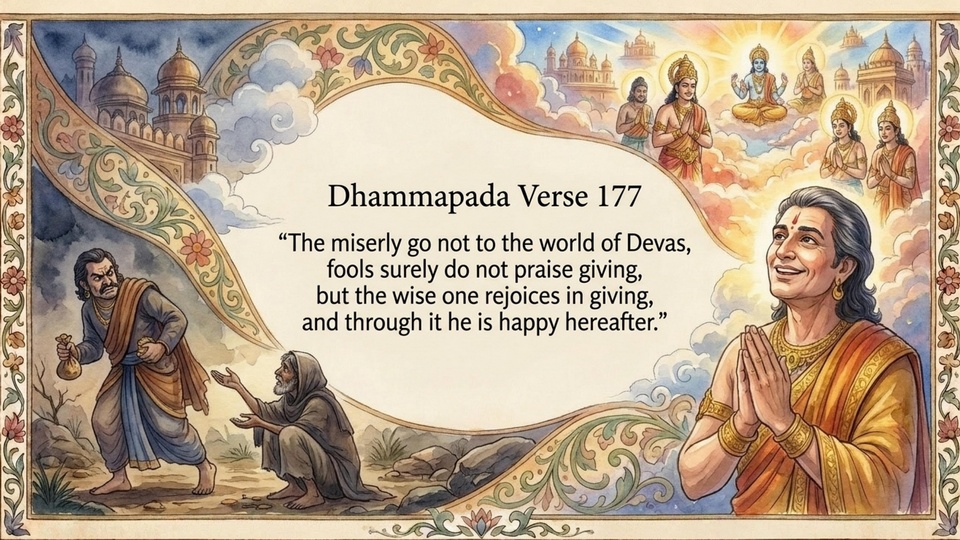
177. Na ve kadariyā Devalokaṁ vajanti,
bālā have nappasaṁsanti dānaṁ,
dhīro ca dānaṁ anumodamāno,
teneva so hoti sukhī parattha.
The miserly go not to the world of
Devas, fools surely do not praise giving,
but the wise one rejoices in giving,
and through it he is happy hereafter.
At the end of the teaching Juṇha was established in the fruition of Stream-entry, and those who had assembled also had benefit from the Dhamma teaching. Juṇha, having become a Stream-enterer, bestowed alms for a period of seven days precisely as the king had done.