13.11 The Story about Anāthapiṇḍika’s Son Kāla
Anāthapiṇḍakaputtakālavatthu
Dhp 178
Burlingame: Virtue Bought and Paid For
Anāthapiṇḍika had a son, who was interested in wealth, but not in listening to Dhamma; the householder therefore offered his son a thousand coins if he would go to the monastery, observe the Observance Day duties, and learn a verse from the Buddha; he did so and attained Stream-entry, and later refused his father’s money; the Buddha explained his decision with a verse.
Keywords: Foremost Disciples, Rich Men, Listening to Dhamma, Offerings
***
“Having sole sovereignty over the earth,” this Dhamma teaching was given by the Teacher while he was in residence at Jetavana with reference to Kāla, the son of Anāthapiṇḍika.
Tradition has it that Kāla, although the son of so distinguished a father, a rich man endowed with faith, never showed any desire to visit the Teacher, or to see him when he came to his father’s house, or to hear the Dhamma, or to perform services for the Saṅgha. Moreover, whenever his father said to him: “Dear son, do not do this,” he paid no attention to what he said.
Now his father thought to himself: “If this son of mine adopts such an attitude as this and acts accordingly, the Avīci Hell will be his end. But it would not look well for me if my son went to Niraya before my very eyes. Now there is no living being here in the world who may not be broken by gifts; I will therefore break him with gifts.” So he said to his son: “Dear son, observe the Observance Day duties, go to the monastery, listen to the Dhamma, and then return. If you will do so,
After his father had repeated his promise three times, Kāla took upon himself the observance of the Observance Day and went to the monastery. But caring not to listen to the Dhamma, he lay down to sleep in a pleasant place and returned home early in the morning.

Thereupon his father
On the following day the rich man sent him forth, saying to him: “Dear son, I will give you a thousand coins if you will stand before the Teacher, learn a single verse of the Dhamma, and then return to me.” Accordingly Kāla went to the monastery and took his stand before the Teacher. But no sooner had he mastered a single verse than he desired to run away. The Teacher therefore caused him to misunderstand the true meaning of the verse. Kāla, failing to understand the verse, said to himself: “I will master the following verse.”
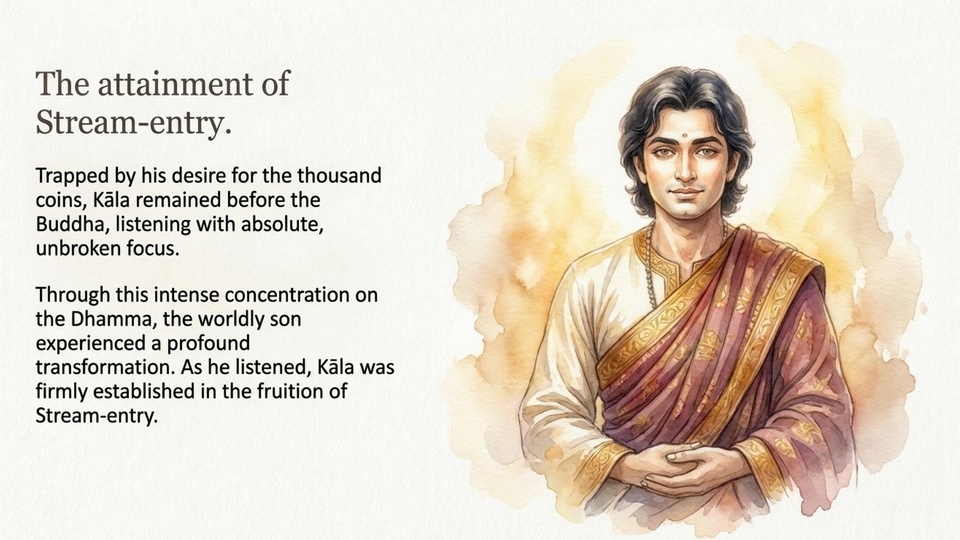
Therefore, he remained and continued to listen. Now those who listen to the Dhamma with a firm resolution to learn, listen attentively; and to those who thus listen, the Dhamma gives the path of Stream-entry and so on. Kāla listened to the Dhamma with a firm resolution to learn; but the Teacher, as before, caused him to misunderstand the true meaning. “I will master the following verse,” said Kāla. So he remained and listened and was established in the fruition of Stream-entry.
On the following day he accompanied the Saṅgha of bhikkhus presided over by the Buddha to Sāvatthī. When the rich man saw him,
The rich man presented rice-porridge to the Saṅgha of bhikkhus presided over by the Buddha, and then presented the same to his son. Kāla sat down in silence, drank the porridge, ate the hard food, and then ate the boiled rice. When the Teacher had finished his meal, the rich man placed the purse containing a thousand coins before his son and said: “Dear son, you will remember that
Then his father worshipped the Teacher and said: “Venerable Sir, the demeanor of my son today pleases me.” – “How is that, rich man?” – “The day before yesterday I sent him to the monastery, saying to him: ‘I will give you a hundred coins.’ Yesterday he refused to eat because I did not give him the money; but today, when I give him the money, he refuses to touch it.”
The Teacher replied: “It is even so, rich man. Today, in attaining the fruition of Stream-entry, your son has attained that which surpasses the attainment of a Universal Monarch, the attainment of the Deva Realm, the attainment of the world of Brahma.” So saying, he pronounced the following verse:
178. Pathavyā ekarajjena, saggassa gamanena vā,
sabbalokādhipaccena – sotāpattiphalaṁ varaṁ.
Having sole sovereignty over
the earth, or going to heaven,
or lordship over the whole world –
better, the fruit of Stream-entry.
At the end of the teaching many reached the fruition of Stream-entry and so on.