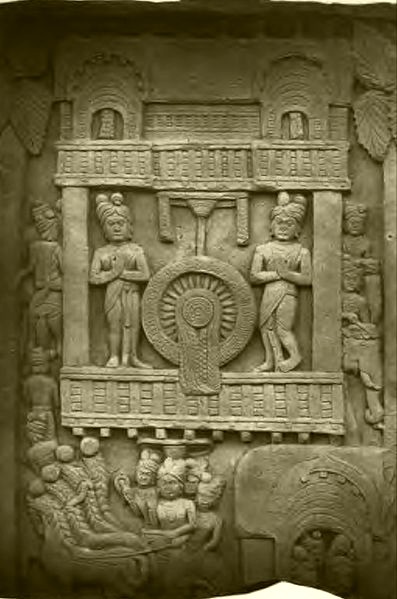
Preaching to King Pasenadi (Barhut)
The Beginnings of Buddhist Art
by A. Foucher
IV
This is a first and certainly very important, but purely material, verification of our hypothesis. There are proofs more subtle than the proof of statistics, which open up deeper views of the development of the ancient Buddhist school. The years have passed, technical skill has increased, the iconographic types of gods and genii have been formed, the gift of observation and a sense of the picturesque have awakened in it: but it remains nevertheless, as regards the capital point of the figuration of Buddha, the docile captive of custom. Around the old themes of the studios, it embroiders, it is true, some variations: it embellishes the
Preaching to King Pasenadi (Barhut)
Henceforward there is only one way, in conformity with the living reality, of conceiving the study of the ancient Indian school. Its history is that of a struggle, more or less surreptitious, between the two tendencies which divided it against itself, an irrepressible desire for new scenes and a superstitious respect for its precedents. On the one hand, it experiences a growing need for the form of Buddha to serve as a centre or pivot for the scenes of his Life; and on the other hand, it accepts as an axiom that, in order to represent the Blessed One, it suffices to do what until then had always been done, that is, to evoke him by the sight of one of his three speaking emblems. Watch it at work. The tumulus of the
All the same, they cannot resist slipping in here and there a few variants, or even trying on occasions some different course. It is under an empty throne, surmounted by a tree, that at Barhut Buddha receives the visit of the nāga Elāpatra; when he preaches in the heaven of the Thirty-three Gods, the motif is in addition graced with a parasol; and this latter, in its turn, takes the place of the tree on the occasion of the visit of Indra or Ajāta-Śatru. At times the throne by itself does the work. In two cases, on the eastern gate of Sāñchī, the school even ventures so far as to avail itself solely of the “promenade”, or
But the boldness of its innovations goes no further, and we very quickly reach the limits of its audacity. We have indeed sketched them above (pp. 4-5), and it would have been superfluous to return to the matter, did we not now believe that we have divined the raison d'etre, and actually the manner of production, of the strange anomalies which at the beginning of this study we had to confine ourselves to stating.
We have, likewise, explained above how - and now we [20] understand why - the artists came into collision with the impassable barrier of ancient usages, when they had to represent the form of the Predestined One in the course of the first twenty-nine years of his life, at the time when his princely surroundings still hid under a mundane cloak the Buddha about to appear. In truth, we were not able as yet (p. 13) to determine exactly, by the aid of the texts, which episode of his youth the faithful had chosen as the principal object of commemoration, nor in what manner the old image-makers must have set to work to commemorate it.
It is curious to note that the sculptors of the second century shared our perplexities in this regard. Those of Barhut adopted the precise moment when the Bodhisattva descended into the bosom of his mother, when, at least, the latter dreamed that he descended there in the form of a little elephant. Cunningham, Stūpa of Barhut, pl. XXVIII, 2. Those of Sāñchī do not represent the Conception, save incidentally; on the other hand, they complacently detail all the circumstances of the prince’s entry into religion, that is, of his flight on horseback from his native town: they portray the gate of the town and several times the horse, the groom and the Gods: they leave to be understood only the hero of this Hegira. As to those of Amarāvatī, on the stele; where they have set one above another the four grand miracles, they employ indifferently, in order to fill the panel reserved for Kapilavastu, - side by side with the tree of Bodh-Gayā, the wheel of Benares and the
Which of these three compositions is the most archaīc and best preserves for us the aspect of the “souvenirs” which the pilgrims of the fifth century were already able to purchase at Kapilavastu? This is a question which we at present find very difficult to answer. If, again, on this point we confide ourselves to the numismatic documents, they will persuade us that from the beginning a certain wavering manifested itself in the choice of the artists and the faithful. Most of the Buddhist coins devote two abbreviations, instead of one, to the Nativity alone; at least, of the five usually associated symbols, the lotus, the bull, the tree, the wheel and the tumulus, the two first must correspond simultaneously to the first of the four great miracles. Apparently, the lotus recalled those which had sprung up spontaneously under the seven first steps of the Master, whilst the bull, almost always flanked by his zodiacal emblem, incarnated the traditional date of the birth, the day of the full moon of the month Vaiśākha. On other occasions, but more rarely, the bull is replaced by an elephant, a plastic reminder of the Conception. Cf. the tables of D. B. Spooner, loc. cit., pp. 156-157. As for the above mentioned interpretations of the lotus and the bull, we, for our part, give them as simple conjectures. In any case, we may at this point observe that in later Buddhism the lotus has retained the symbolical significant of “miraculous birth”, and that the bull appears again with its astronomical value on one of the best-known bas-reliefs of the Lahore Musuem (cf. A Grunwedel, Buddhistische Kunst in Indien, 2d ed., p. 121, or Buddhist Art in India, p. 129). The lamented Dr. Th. Bloch in one of his last articles (Z. D. M. G. 1908, vol. LXII, pp. 648 and sqq.) thought he recognized in a defective photograph of this bull with the hanging tongue the image of a wild boar, and he built up a whole theory on this mistake: it suffices to refer the reader anxious to clear up this matter with his own eyes to Burgess, Anc. Mon. Ind., p. 127. It may be [22] also, although we possess no concrete proof of this, that the gate through which the Bodhisattva had been cast by his vocation out of the world may, at an early date, have found copiers and amateurs. But these are merely accessory questions: what is important here is that only the traditional avoidance of images, inherited from the humble pioneers of former days, can give us the key to the later improbable compositions, child-births without children, rides without riders.